

When I prepare to compose these editor’s notes, I often wonder if I’m immediately offering you a lifeline to hold on to through the issue (assuming you read the editor’s note). Do I divert you from discovering all the possible interpretations, all the potential tributary connections you could create, if left on your own, as you wade between the covers?
Maybe. But I also consider these notes not so much as a map to one particular end, but more a compass, revealing my streams of thought, the course taken to helm each poem, story, and essay into sequence, so when you’re ready to dip your toes into the first page, you’ll have a confident heading.
As is probably clear from the aquatic-esque word choices sprinkledin the paragraphs above, most of the writing in this Summer volume, titled “Waterlogged,” engages in one way or another with water. You might even say the writers and poets have written—or logged—their stories in stream, river, ocean, and lake; in blood, how it flows or stops flowing to the heart; in sound, how we hear through waves; in sex, fluid as our desires may be; or, in how the urge to disrobe can overwhelm us, so we lay it all bare.
Each piece in Volume 53.4 is confessional, personal, occasionally political, and, at times, seemingly obsessive. This means, like a red sky in the morning, take warning: sailing won’t be smooth. Think of it like you’re on a luxury cruise in the Antarctic (one without rodents, of course): the ship will teeter, bergs will threaten the ice-strengthened hull, but you’re safe. You’ll make it back to shore, well fed and a little wiser.
- Elena Bentley, Editor
INTERVIEW WITH A NUDIST | Rolli
Scene: A muddled apartment. An elderly man (Colin) is sitting cross-legged in an armchair, nude. Opposite him sits a middle-aged man (Arthur) wearing a suit, notepad in hand.
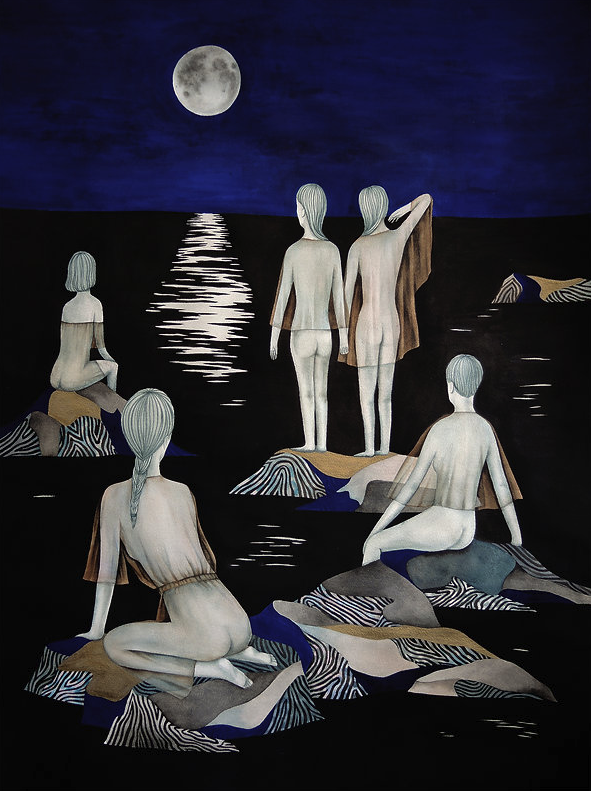
COLIN: I apologize for the state of my apartment.
ARTHUR (looking around): Have you lived here long?
COLIN: Only forty years or so.
ARTHUR: And you’ve never thought of moving?
COLIN: That would be disrespectful to the dust. Dust is the dandruff of an intellectual—a sure sign a person prefers contemplation to running a cloth over everything. If I don’t see a speck of dust in someone’s home, I never go back. For most of my life I didn’t consider myself an intellectual, but I’ve grown lazier over the years. Doing nothing gives one plenty of time to contemplate everything. Thinking isn’t the style of the time—it’s considered a deformity—so I do it in secrecy. The fashion will come back, though. Just give it a century or two.
ARTHUR (opening the notebook): I’m not sure where to begin … .
COLIN: You could always take your clothes off.
ARTHUR (laughing): I don’t think I will.
COLIN: Well, you can ask a naked person anything. He isn’t about to fold his arms and say, “Oh, that’s far too personal.”
ARTHUR: Then I’ll try to be as inquisitive as possible. I’ll start by asking you about your new autobiography, Becoming Naked.
COLIN: An autobiography is just the letter “I” repeated for three-hundred pages. Only people who are dying or beautiful should write their memoirs and though I’m neither of those things, I decided to try.
ARTHUR: Can you explain the title?
COLIN: The latter part of my life has been an infinite striptease—an attempt to remove everything from myself that isn’t myself. Every belief and costume I was force-fed and coerced into over the years by the people around me, by society. Even the writing of the book was a part of that process. After all, the best writers undress themselves on every page—they’re naked under paper sheets.
DESALINATION | Mitchell Bodo
after Megan Fernandes
I chose this dark
where a sunken ship slips
deeper into unknown waters, where
it’s said that even blue whales can get it on
away from watchful eyes.
In a movie I love, three men sit in the hold
of an old fishing vessel, inspect each other’s scars,
and sing about going home. I think bottoming is something like this:
the way you let the ocean
into your boat. Make of me a porthole.
Let light loom. Make me uncanny like the X-Men.
A nightcrawler. A pincered carcass on the ocean floor; some inking octopus.
Caught in the fishnet stockings
tossed out to sea, I’m at a loss for words.
I grip the pitching mast, record the depths of doldrum winds.
Half-metre waves unfurl, obscure a bloated body preserved for decades
without a blinking piece of gold
in waterlogged light. In lifeguarding classes,
they taught us to reach out to the person we’re trying
to save with a foot instead of a hand. Most who would drown
pull others down with them. I am
grateful to you, who sifted this marooned sailor.
I come to you now saltwater drunk. A boy full of holes.
Enjamb me like the tide into the shore.
PLEASE | Heather McCabe
I
On the midsummer day with asphalt baking, a jet roars overhead, followed by another and another. We stand frozen in the stillness. Water runs down our legs from the saturated hems of our swimsuits to the parched cement pool deck that grabs at our feet. The F-16s slice clean lines across the sky, leaving trails of vapour in their wake. We exchange apologetic smiles in our world of silences and silencing. The hesitant breeze brushes against our drying bodies and the air is so full with noise as to be empty. In the pool, we can see the frantic movements of our teammates, the way their arms are cutting cleanly from water to air and back. How the water erupts white at their feet. Each moving body is a moment of chaos in the water’s calm. We watch them, silent in their struggle as the planes pass overhead, through these seconds that feel like hours. In a moment, a race is won and a race is lost. Above us, fighter pilots perform aerial drills and shake the earth beneath them.
* * *
In her introduction to Quantum Listening1, playwright and poet Carole Ione Lewis references a study conducted by R.I.P. Hayman in 1976, which demonstrated that the tympanic membrane—the eardrum—reacts to sounds in our dreams as though they are real, outside of us. Lewis writes, “I take this as tangible evidence of an organic Deep Listening mechanism within our physiology. This membrane must also respond to ‘imagined sounds’ and ‘remembered sounds,’ since both forms are accessed by ‘inter-dimensional listening’, which is very close to listening in dreams.” I think of sounds that have woken me in the night—the creak of my neighbour on the stairs, doors opening and shutting, and, once or twice, car crashes that happened only in my dreams.
II
Sound returns like waking—come from below, the sun shines too brightly—and we are inarticulate with our newfound blessings. A whistle balancedbetween lips blares and our heads swivel in collective curiosity. Minutely,timers click in hands. We vibrate in anticipation of the results. In the bullpen, we stand shoulder to shoulder, preparing for the next heat with shaking hands and shallow breaths. We draw our swim caps down tightly over our ears. With goggles on, the texture of the world starts to fall away. All there is, is the surface of the water and our bodies diving into it. Under our swim caps, our ears thrum with blood and the sound of our hearts beating fills our interstices. We stand behind the diving blocks, awaiting directions. We imagine each next step: right foot up, left foot up, right foot on the platform edge, left foot back. The mechanical shout of the announcer comes over the speakers and we set our hands down. Bent in half, tipping toward the clear surface of the water, our only hope is for the start to come.
* * *
I first heard about Marilynne Robinson’s Gilead2 from my college roommate, who had gotten the recommendation from a mutually beloved professor. It was the summer after our senior year and we were holed up with family and friends as the first months of the pandemic raged. She posted about it on Instagram, on an account we and a few other friends used to share book recommendations—in the caption, she called Gilead “one large holy moment. It took me three years to get around to reading it, despite buying my own copy at the used bookstore a few blocks from our first post-college apartment. It moved from that first apartment, where I kept my books on the top shelf in my closet, to the second, where I set up a bookcase, to the third, where I lived alone two states away with the same bookcase and most of the same books. I think I was scared of loving it too much. It was obvious I would love it—my roommate and I had spent many nights talking about God or the idea of God or her assurance in thethousands-of-years-oldness of her soul or my hesitance at naming such a thing. In Gilead, the dying preacher John Ames writes to his young son, dispensing wisdom in anticipation of his death. Much of this wisdom revolves around Ames’s appreciation for the mysteries of the world and the assurance he feels that neither God nor man can truly account for them. He says simply, “This is an interesting planet. It deserves all the attention you can give it.”
1 Carole Ione Lewis, “Introduction” in Quantum Listening by Pauline Oliveros (Silver Press, 2024).
2 Marilynne Robinson, Gilead (Farrar, Straus, and Giroux, 2004).

OBSESSIVE | Jamie Anderson
I can’t stop wanting. I suck your fingers, teeth catching
on the ridges of knuckles, and I want
a whole arm down my throat, thumbing at my stomach.
Later, I’ll be embarrassed at the wet slurp of my mouth.
Later, I’ll tap out a confession to my downstairs
neighbour, telling them I wanted
to taste your deodorant. It smelled like oranges.
Sorry. Sometimes, I’m afraid no one likes me
enough to notice my deodorant. On the phone,
my dad tells me to relax and dip my toes in the ocean.
I go down to the beach and chicken out. I don’t want
anyone to see my fucked-up toenails, a shred of teal
clinging to the cuticle. Instead, I gnaw on a hangnail
until it becomes a glorious open wound. I leave bloodstains
inside my 2008 Chrysler. Tonight, when I pick you up
for drinks you’ll sit in my blood, unknowing.
Then I’ll beg you to dig your nails
into the white hollow of my throat.