
The older I get, the more I appreciate Saskatchewan—the place where half of my family, kin, and ancestors have called home for hundreds and thousands of years. I don’t just covet the spaciousness (we have a total population of about 1.3 million inside 652,000 km2), or admire the geographical diversity (boreal forest up north, prairie in the south), or marvel at the vibrant sunrises and sunsets that would’ve made even Bob Ross stop, look to the sky and shout, “I gotta paint that!” I also appreciate the communities and programs that encourage the growth of new writers.
I consider myself still emerging, both as an editor and a writer, and I am where I am today in my journey because of the support from organizations like the Saskatchewan Writers’ Guild (SWG) and the Saskatchewan Ânskohk Writers Circle Inc (SAWCI). Writers can also hone their skills with the support of the Sage HillWriting Experience, SKArts, Creative Saskatchewan, Sask Festival of Words, and Sâkêwêwak, to name a few.
Maybe it’s the landscape, maybe it’s the community, but something’s in the water. I mean, the sheer number of successful and well-known writers who were born and raised here, many of whom have been involved with Grain, whether as contributor, editor, or committee member, is far too lengthy to list here.
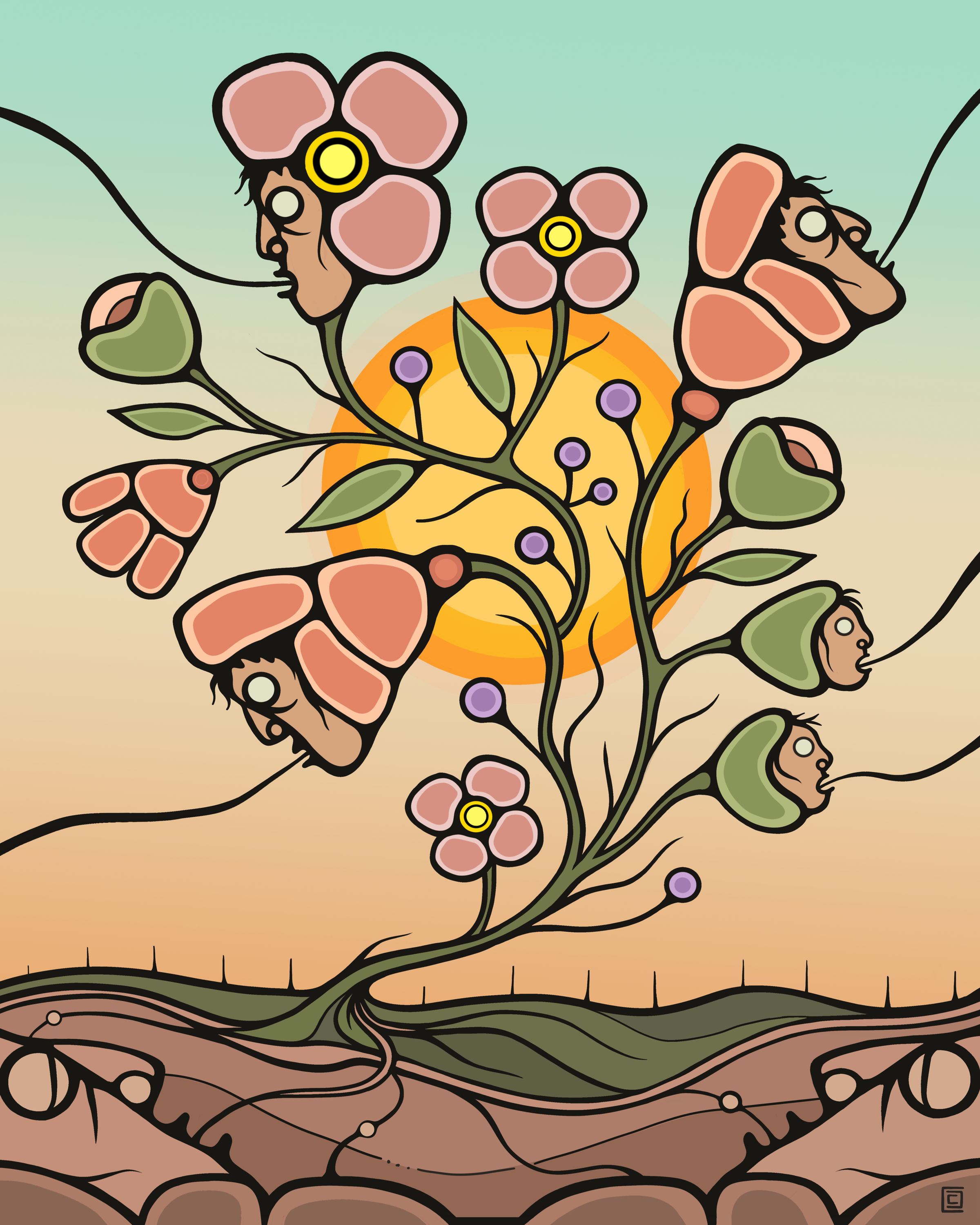
For this special issue, however, we’ve harvested a bountiful crop of writing by new and emerging Saskatchewan writers. I can promise you’ll go through the whole gamut of human emotion, laughing out loud to shedding a few tears.These writers and poets will have you contemplating parenthood, interrogating social media and the probable future of robotic romance, and leave you questioning the importance of garlic. I’m also extremely grateful to Warren Cariou, our Blast From the Past poet, who generously contributed some reflections on his experience as once a new and emerging Saskatchewan writer himself. And if that weren’t enough, this issue features the work of Cree visual artist Chris Chipak—a rising star in the art world— whose piece “Stained Glass,” a gorgeous rendering of our provincial flower, the Western Red Lily, gifts us the perfect cover.
From first seeding the idea to baling up the finished copies, I can say on behalf of the entire Grain team, it’s been an honour to nurture, celebrate, and give space for Saskatchewan’s new and emerging writers.
- Elena Bentley, Editor
BEAUTIFUL, WONDERFUL, MAGICAL LIFE | Tyler Lee

You’ll have a beautiful life and do wonderful things. You’ll spit up on your pink polka-dot onesie, an archipelago of drool dotting the fabric from the soft-stitchedcollar,toasinglepinkdotrestingjustaboveyourheart.You’llfall asleep in the laundry-fresh canary-yellow one with the cartoon giraffes—its soft savannah lifting and falling a near-invisible distance, as you fill your thimble lungs with newborn air, then breathe it back into the blanket, the basinet, the antiseptic sky of the second-floor hospital room. You’ll roll your perfect little eyeballs around ceiling tiles, quilt squares, soft smiles on a fresh face. Jam your fist in your gummy mouth, trail slobber down your precious knuckles. You’ll goo, gaa, fuss, and cry with magical melodies, your initial incantations chanted. The first bits of yourself to trickle out into the world and give shape to the air around you.
You’ll live in a beautiful house—the outside walls a soft blue-grey, like the prairie sky soon after it stops raining. Backyard as wide as the whole world. The greenest green grass to cartwheel and somersault through. Mulberry bushes along the side fence, the fence you’ll share with your favourite neighbour. A soaring willow tree with strong, outstretched arms—good for tire swinging, even better for climbing—growing out of soil soft enough to fall on, but still hard enough to feel. And you will. You’ll swing and jump, climb and fall, and you’ll feel it all.
Your bedroom will be on the second floor, just across the hall from your parents’ room. Through massive movie-screen windows that face west, you’ll see living sky sunsets soak the heavens in amber, amethyst, and amaranth. Watch angel feathers fall from high and blanket the horizon in soft white. Spy jackrabbits bounding and rolling across winter snow, squirrels scampering along your windowsill in spring.
Your mom will be fun, but the good kind of fun. Technicolour streaks through her hair, change by the season: magenta, turquoise, sapphire. She’ll wear cartoon-thick, fairy-tale-bright, golden bangles on her wrists that jangle together like windchimes when she hand-talks, gesturing with the same energy and excitement that burns inside her voice. Like she has so much to say she can’t rely on words alone and always needs to speak two languages, one on top of the other.When you’re four, your mom will leave you untended in the living room while she toasts sourdough and stirs scallions into tuna salad. You’ll draw a picture of your house on the eggshell-white living room wallwith Crayola markers: a big blue square with a triangle roof, Burnt Sienna willow tree covered in Forest Green leaves, a little LifeSaver tire swinging from a branch. A big bright yellow sun in the sky, smiling. You’ll always draw the sun smiling. When your mom jangles back into the room with a tray of sandwiches, celery sticks, fruit punch in those little silver pouches with the straw that needs jabbing through the top, she won’t yell at you. Won’t wrench the marker from your skinny little fingers or throw the box across the room. She’ll fetch a small can of chestnut-brown wood paint from her studio, brush four clean straight lines around your picture, a gallery-perfect picture frame around the scene. She’ll pass you a marker from your pack, hold your tiny hand inside hers, help you sign your name in the bottom corner of your masterpiece.
SONNET FOR BETH | Jeremy Desjarlais
You reach down into the river, catch songs
in nets, both hands against the rope emerging like
latticed suns. Your pink, puffy flesh constellated in
the cold, water moving over minute hairs and the
too-tight ring that clacks in Morse code
on metal bowls
filled with cookie dough you sneakily eat before the greedy
oven asks to be fed. Two dozen looks closer to seventeen,
and we often wonder why we even turn the oven on. I move
to the sugary measuring cups and spoons, you to the bag of flour
and butter that need returning. The water is not yet hot, and
this reminds me of
the time you reached down into
the river and caught songs in nets.
RIDE OF THE VALKYRIES | Benjamin Johnson
Picture me, ViKween, in a custom cream Aadnevik gown trimmed with ostrich feathers and a robin’s egg Versace coat, hood and sleeves lined with white fleece, as I lean over the railing of the M. Y. Øyvind and spew my guts into the dark waters of the North Sea. Picture me gazing down with bleary eyes at my wig floating atop the ocean, a wispy blond jellyfish waving goodbye just before the boat’s undertow sucks it, poof, away. Picture disco lights dancing on the back of my bald head. Listen for the sounds of Norwegian pop, margarita blenders, and bopping winter boots.
I’m not usually such a barf bag out at sea. I grew up on a fishing boat and earned my sea legs before I could crawl. Of course, that was before I cut ties with my great-grandmother, Guðrun, and quit my village for the Oslo drag scene. It’s been awhile since I’ve been on open water, and it’s my first time ever in heels, but when the captain of the Øyvind asks you to come aboard for their annual big gay DANSE FRA DØGNVILL spectacular, why, you simply have to hoist anchor, darling. What you don’t have to do is drink a clam juice cocktail that some handsome stranger passes you after your lip-sync performance to “Vill ha dig.” And you certainly don’t have to down half of it in one gulp without checking the ingredients. Because you’re allergic to shellfish, and now you’re going to puke until you die. And to make a bad situation worse, you left your EpiPen on shore because it wouldn’t fit inside the envelope-thin, fur-lined clutch that matched oh-so-nicely with your shoes. Who would suspect shellfish out at sea, right? You should have, moron.
Picture me, because my eyes are swelling shut. Bald, puffy, bent over a railing, fly-away vomit dribbling off my chin, alone in the freezing cold of the sea and the sky. Will they find me out here on the wrap-around catwalk after the party is over? Splayed like the Black Dahlia, legs and arms akimbo, my fur coat pooled artistically around me? Even if I can’t go get help, I’m still capable of draping myself.
I stagger back from the railing and collapse to the deck, giving the night sky glamour, elegance, beauty. I bat my swollen eyelids. I imagine my corpse as they’ll find it, frozen but smiling, skin crystallized, eyes as icy blue as my coat.
“Ma’am, can I get you anything to drink?”
Picture me, vomiting into the air like a whale’s blowhole, ejaculating old clams and stomach juice at the moon. My face: splattered. My dress: soiled.
My dreams of an elegant corpsehood: dashed. I tilt my head back and through the slits of my eyes spy one of the ship’s waitresses standing there in her fur-kini and sailor’s cap, a tray full of steaming hot choc-tails balanced in her mittened hands. “You don’t look so good, ma’am. Would a hot beverage help?”
I wheeze out a response that I’m not sure is actually words and flop onto my belly like a harbour seal, dragging myself toward the waitress with rhinestone fingernails. She barely blinks, has probably had a dozen drunk guests pull this sea-witch routine before. “Or can I recommend our coconut shrimp cooler?” she asks. “Do you like a drink with zing?”
“Girl, scooch your cooch,” says a voice. “My Judy needs help.” Picture a new shape looming over the fur-kinied server girl, solidifying into a triple-decker red velvet cake frosted with diamonds and a cherry afro on top: Miss Ragna Roxie, in the goose-bumped flesh. She waltzes up to my thrashing body and pulls me to my feet with arms like twin forklifts. I gaze blearily into her impeccably made-up face, gold glitter splattered across her eyelids like the stars I’m dying under. “If you throw up on my dress,” she says, “I’ll rip your legs off.” Picture me forcefully swallowing my vomit.
SOFT ENOUGH | Deidre Powell
I was not born soft.
Youngest in my class,
I learned to guard my lunch
from Conchita,
who knew I would not cry
and give more.
Life did not reward softness.
There were papers to sign,
the hydro bill to outrun,
children to lift without dropping anything.
The world mistook my backbone
for an invitation to lean harder.
Early, I learned
to hold a house upright
with one shoulder.
Silence took up residence
between my ribs.
Softness came late,
like sleep that leaves the lamp on,
listening for storms.
You came,
with salmon and a vegetable
I didn’t know the name of,
learning my body with me,
staying warm enough
that I forgot
what I was bracing for.
I rested without rehearsing goodbye.
And still,
I flinch
when a door closes too quietly.
My hand checks the lock
twice before sleep,
like prayers
I never stopped saying.